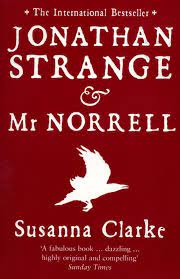
Another book fresh out of the bookcase; I give you Jonathan Strange & Mr. Norrell. It took me longer than expected, but then I had the usual experience where the I start out slow then once I hit the halfway point I was cruisin’ for a bruisin’.
The book has three sections; the setting being England and the Continent in turn of the century 1800s. The first section, “Mr. Norrell”, introduces us to, obviously, Mr. Gilbert Norrell, a magician since childhood who prefers to play it safe and goes by his own strict guidelines on the gentleman’s way of magic. He is very book driven and wants to be the only, I guess you could say certified, magician in England. So once he moves to London, he begins to dismantle gentleman magic social groups, have people refute their magicianship, and buy off any books that are of the magic variety, all the while establishing himself within the social circles of the political and wealthy. The second section, “Jonathan Strange”, introduces us to, you guessed it, Jonathan Strange, a well-to-do gentleman with no career direction. He is one who has a random encounter with a vagabond magician and becomes enamored with magic, therefore committing his life to it. With an incredible natural talent, Strange rises to prominence in London in military and political social circles. Very reluctant, Mr. Norrell takes Strange under his tutelage for formal training. The third section, “John Uskglass”, is the culmination of both the previous two sections, so I will not go into spoilers on that one.
Two things struck me while reading Jonathan Strange & Mr. Norrell, actually three things. First off, I found this out before reading, but there is a BBC adaption of the book and it looks entertaining, and as I was reading, there were a lot of moments where I would confirm the adaptability of the book. Second, because my husband and I are currently reading the Harry Potter series together, I was doing a lot of comparing between the two in the sense of how magic is used as an element of the story. There were also a few moments where I was thinking that perhaps these two universes have a possibility of being under the same roof given the timelines, setting, and nature of the stories. And lastly, stemming off of the second point yet going in the opposite direction, how different and open the direction is that an author can go with a given topic.
Overall, Jonathan Strange & Mr. Norrell was one of the best examples of world building that I have read thus far in my life. Yes, and this was something I read from other reviews, there are a staggering amount of footnotes, which apparently was a huge turnoff for people. To me, once you have read House of Leaves by Mark Z Danielewski, any amount of footnotes is doable. I do not know how necessary it was for some of the footnotes, but at the same time, once you have gotten to know the characters like Strange and Norrell, you will understand WHY there are so many and the content of them. Susanna Clarke does so wonderful in giving you so much detail and backstory of things and characters that you are connected and invested. The footnotes are who Strange and, most especially, Norrell are. Working in magic, books and research are so much incorporated into their lives that it is a science, therefore giving this book a feeling of nonfiction.
To expand on my second and third things earlier, with Harry Potter, you are given a very clear sense of good vs evil and moral fiber. With Jonathan Strange & Mr. Norrell, you are given a more grown up and complicated look at where something such as magic can go seriously wrong vs remain good and wholesome. As I read, the characters I thought were going to be enemies and designated as the bad or good were changing and evolving to a point where eventually, everyone was either mostly good or mostly bad. The biggest one was that Strange and Norrell, even if we perceived them to be enemies, came to realize that they will disagree and have different views on subtopics in magic, especially when it comes to John Uskglass, but they are more than anything colleagues. You cannot have one without the other and they have to be able to work together. Even those who became enemies in the end are not so much enemies, such as Mr. Lascelles, who I thought was going to be helpful but really he was helpful to suit his personal gains, or the Gentleman with the Thistledown Hair, who again we told from the beginning is characterized as a trickster when he also makes it a goal to give Stephen Black a voice and purpose beyond his station and race. There are no enemies or heroes, just complicated beings.
I would absolutely read this again, and it makes me want to go check out the show as well. For a first book by Susanna Clarke, this was very well done. I would recommend reading this especially for those who are looking for something more complex in character development, moralistic situations, and world building.
Thank you everyone for continuing to follow my reviews. Enjoy the amazing weather.
10/10

 Chofa Times on the Chofa