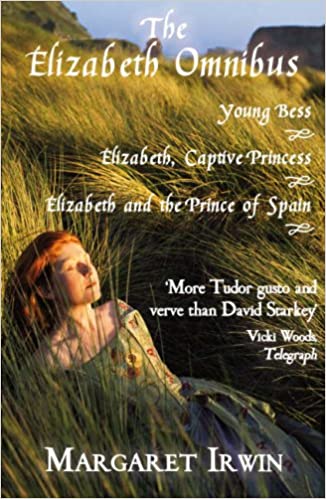
Good morning, everyone! It took me about five months to read this three-books-in-one volume, what with the holidays and what have you, but it is over and I am so glad to be done with it.
The Elizabeth Omnibus covers three books by Irwin about the beginning of the Elizabethan era, starting with the death of Henry VIII and ending with Elizabeth finally becoming queen. Young Bess covers Henry’s death, the beginning of her brother Edward’s reign, and some bullshit where she, an eleven-year-old (I do not know, the references to her age jump around so much throughout the whole book that I had lost track and forgot to care), falls for a 30-something manipulative jerk off. Captive Princess covers Edward’s reign until his death, her sister Mary becoming queen, and Elizabeth being imprisoned in the Tower because of some rebellion that she apparently did not start up on her own merit (based off of the way she presents herself, I call lies, but who am I to argue with history, which says she did not). Elizabeth and the Prince of Spain brings Elizabeth out of the Tower because Prince Philip, the heir to the Spanish empire which basically covers the entire known world, married Queen Mary because of political (or greed, the real reasons for why people conquered places, hiding it behind religious value) gain when he really wanted Elizabeth because she is a honey badger who does not give one bit of f**ks.
What did I learn in all of that reading? I am reminded that, in honor of today being international women’s day, that Elizabeth was so good at playing politics against the boys that she would probably win Survivor. She is such a player it is unreal; I almost started feeling bad for Philip because he is so egotistical and would believe everything she would say because it fills said ego, but then she would turn around and laugh about what an idiot he is for believing her; she basically used him to secure the throne and, who knows, because the book ended at the beginning of her reign, she could very well do it to get out of the war he placed England in.
The first book was okay; I was starting to become disinterested when it became a game of which Seymour brother is the biggest idiot. The second book is when I think I gave up reading it and just wanted to finish. Everything became this roller coaster of children being used for political gains by marriage and being a baby factory, which is another reminder of how I am glad this is not so much of a thing in this time we live in. The third book kind of picked up; it was more entertaining, again, to read about people being dumb because they thought with their dick and claimed God.
I will certainly not be reading this again. I think it was more or less the topic and the choices of things talked about; the writing itself was not bad, I found some well written quotes in there, but for me that was not enough to overcome the disinterest. Who knows, maybe I would have enjoyed it more if I were back in the phase of being really into the Elizabethan era. I had written a paper for an art history class, I think it was Age of Enlightenment, and during that period it was such a huge thing to be a creative or scholar of any kind because at the time the major powers of the world, England, Russia, and I believe France, were all ruled by women, and they heavily pushed for people to learn and grow instead of being stuck on old principles that were not getting anyone anywhere. I digress.
On the flip side, because of the more simple writing, I would recommend this for an upper grade school level reader, or just someone who is into this topic. Irwin got an incredible amount of praise for these books, I just do not really see where the praise goes to. If you would like to overcome this read, and maybe have a discussion on it, you can find it here.
4/10

 Chofa Times on the Chofa